


DDA: Disability Discrimination Act Australia
The Disability Discrimination Act 1992 (DDA) is Australia's landmark federal law protecting people with disabilities from discrimination in all areas of public life, including employment, education, accommodation, and access to the internet and digital services.
Disability Discrimination Act (DDA) 1992 Explained
The Disability Discrimination Act 1992 (DDA) is Australia's primary federal legislation prohibiting discrimination against people with disabilities. It was enacted by the Commonwealth Parliament on 5 November 1992 and applies across all states and territories, covering a broad range of life areas from employment and education to premises and access to services.
The DDA applies to all individuals, businesses, government agencies, educational institutions, and organizations that provide services, employment, education, or access to premises in Australia. Unlike some other nations' laws, the DDA takes a complaints-based enforcement approach, administered by the Australian Human Rights Commission (AHRC).
For digital accessibility, the Australian Government's web accessibility requirements reference WCAG 2.1 Level AA as the technical standard, with all Commonwealth agencies required to meet this standard. While the DDA itself does not explicitly mention websites, the AHRC and federal courts have confirmed that websites and digital services fall within its scope.
“The DDA makes it unlawful to discriminate against a person in many areas of public life because of their disability. It is designed to eliminate, as far as possible, discrimination against people with disabilities.”
Where the DDA Applies
The DDA prohibits disability discrimination across a wide range of areas in public life.
Employment
Covers hiring, promotion, training, dismissal, and all employment conditions across all workplaces.
Education
Schools, TAFEs, universities, and other educational providers must not discriminate based on disability.
Accommodation
Protections apply to renting, buying, and accessing residential and commercial premises.
Goods & Services
Businesses and online services must not discriminate when providing goods, services, or facilities.
Digital Access
Websites, apps, and digital content are included — confirmed by AHRC and court decisions.
Who Does the DDA Apply To?
The DDA applies broadly across Australia, with different requirements and expectations for government agencies versus private sector organizations.
Organisations That Must Comply
- All Commonwealth, state, and territory government agencies and departments
- Private sector businesses providing goods, services, or facilities to the public
- Schools, universities, TAFEs, and other educational institutions
- Non-profit and community organisations providing services or programs
- Online businesses and websites accessible to Australian users
- Landlords, agents, and property managers for residential and commercial premises
Government vs. Private Sector Obligations
- Commonwealth agencies: Must meet WCAG 2.1 AA for all web content; mandatory under the Digital Service Standard
- State/territory governments: Generally required to meet WCAG 2.1 AA; specific requirements vary by jurisdiction
- Private businesses: Must not discriminate; inaccessible websites can result in DDA complaints
- Educational institutions: Must provide reasonable adjustments for students and staff with disabilities
- The DDA allows for "unjustifiable hardship" defense in limited circumstances
Key DDA Milestones & Deadlines
The DDA has been supported by subsidiary standards, advisory notes, and government digital policies that define technical expectations for accessibility over time.
| Requirement | Who It Applies To | Deadline | Status |
|---|---|---|---|
| DDA enacted — broad discrimination protections | All organisations & individuals in Australia | Nov 5, 1992 | In Force |
| AHRC Advisory Note — websites covered under DDA | All Australian website operators | 2014 | In Force |
| Commonwealth agencies — WCAG 2.0 AA | Federal government agencies | 2015 | Past Due |
| Digital Service Standard — WCAG 2.1 AA | Commonwealth government agencies | Dec 2024 | Past Due |
| Ongoing DDA complaint investigations | Private sector organisations | Ongoing | Active |
| Anticipated Disability Standards for Digital Access | All sectors — private & government | TBD | Proposed |
Consequences of Non-Compliance
The DDA is enforced through a complaints-based system administered by the AHRC. Non-compliant organizations face formal investigations, court proceedings, financial penalties, and significant reputational risk.
AHRC Complaint
Anyone can file a DDA complaint with the Australian Human Rights Commission, including for inaccessible websites.
Court Orders
The Federal Court can order compensation, require remediation, and issue injunctions against non-compliant organizations.
AHRC Investigation
The AHRC investigates complaints and may conduct its own inquiries into patterns of systemic discrimination.
Public Disclosure
AHRC publishes findings publicly, and confirmed cases of discrimination cause lasting reputational damage.
Federal Court Action
If conciliation fails, complaints proceed to the Federal Court — legal costs and damages can be substantial.
What DDA Compliance Requires for Websites
The AHRC and Australian Digital Service Standard reference WCAG 2.1 Level AA as the benchmark for digital accessibility, organized under four core principles.
Text Alternatives
All non-text content, including images, icons, and buttons, must have descriptive text alternatives accessible to screen readers.
Time-Based Media
Pre-recorded audio and video content requires captions and audio descriptions. Live streams require real-time captioning.
Adaptable Content
Content must retain its meaning when presented in different formats, including by assistive technologies such as screen readers.
Color Contrast
Minimum 4.5:1 contrast ratio for normal text; 3:1 for large text. Information must never rely on color alone.
DDA vs. Other Accessibility Laws
Understanding how Australia's DDA fits within the global landscape of disability discrimination and digital accessibility legislation.
| Law | Region | Applies To | Web Standard |
|---|---|---|---|
| DDA | Australia | All organisations operating in Australia — all sectors | WCAG 2.1 AA (government mandate) |
| AODA | Ontario, Canada | All organisations in Ontario with 1+ employees | WCAG 2.0 AA |
| Equality Act 2010 | United Kingdom | All service providers, employers, and public bodies | WCAG 2.1 AA (public sector mandate) |
| EAA (EU Directive 2019/882) | EU | All EU member states — private sector B2C services | WCAG 2.1 AA |
| ADA | USA | US businesses — federal and commercial entities | WCAG 2.1 AA (court-interpreted) |
| WCAG 2.1 Level AA | Global | Referenced by accessibility laws worldwide | The standard itself |
DDA Website Compliance Checklist
Use this checklist to evaluate your website's DDA readiness.
Content & Media
- All images have meaningful, descriptive alt text
- Videos have accurate captions and transcripts
- Audio content has a text alternative or transcript
- PDFs and documents are tagged and accessible or available in accessible format
- Headings are used in correct hierarchical order (H1 → H2 → H3)
Visual Design
- Text contrast meets 4.5:1 minimum against its background
- Large text meets 3:1 contrast ratio minimum
- Content is usable when browser text is resized to 200%
- Colour is not the only means of communicating information
- Focus indicators are visible when navigating by keyboard
Navigation & Keyboard
- All interactive elements are reachable and usable via keyboard
- Skip navigation link present to bypass repeated menus
- No keyboard traps — users can navigate freely in and out of components
- Navigation is consistent and predictable across all pages
- Page titles are unique and descriptive for every page
Forms & Feedback
- All form fields have visible, programmatically associated labels
- Error messages clearly identify the issue and provide guidance to fix it
- Accessibility feedback or contact mechanism published on site
- Accessibility statement or policy documented and publicly available
- Process in place to handle DDA complaints or accessibility requests
Meet DDA Requirements with One Accessibility
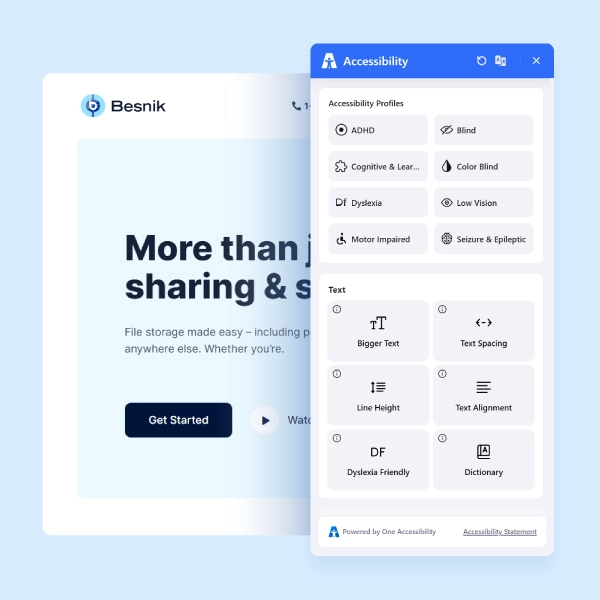
One Accessibility is a WordPress plugin designed to help website owners achieve and maintain accessibility compliance — including the WCAG 2.1 AA standards referenced by the Australian Digital Service Standard and expected under the DDA framework.
- Works with Elementor, Gutenberg, Bricks, Beaver Builder, Divi, WPBakery
- Smart conditional presets — different settings for different pages
- Visual drag-and-drop editor — no coding required
- Default accessibility preset activates instantly on installation
- Aligned with WCAG 2.1 AA — the DDA digital accessibility benchmark
Text Resizing
Visitors can increase or decrease text size to their comfortable reading level.
High Contrast
Toggle high contrast mode for users with visual impairments or light sensitivity.
Keyboard Navigation
Enhanced keyboard navigation support for users who cannot use a mouse or touch.
Screen Reader Ready
Fully compatible markup for JAWS, NVDA, VoiceOver and other screen readers.
Reading Mask
A reading guide overlay that helps users with dyslexia follow lines of text.
Instant Activation
Default preset activates on install — your site improves accessibility immediately.
Frequently Asked Questions
Common questions about DDA compliance, who it affects, and what organisations need to do for digital accessibility in Australia.
Make Your WordPress Site DDA-Ready
Join thousands of sites using One Accessibility to meet global accessibility standards — no coding required.