

Section 508 U.S. Government Accessibility Standard
Section 508 governs accessibility across the U.S. federal government. It shapes how agencies and vendors build digital technology. If you sell to the federal government, compliance becomes a contractual requirement, not a choice.
Section 508 Requirements for Federal Agencies and Vendors
Congress passed Section 508 as part of the Rehabilitation Act of 1973. The amendment took effect in 1998 and grew from 29 U.S.C. § 794d. It requires federal agencies to make their technology accessible to people with disabilities.
The law covers information and communication technology (ICT), including websites, software, electronic documents, and hardware. It also covers phones, call centers, and other digital systems that federal agencies use.
The U.S. Access Board issued a major refresh of the standard in 2017. The refresh took effect in January 2018 and adopted WCAG 2.0 Level AA. Federal agencies must meet this benchmark across nearly all public-facing and internal content.
Vendors selling technology to the federal government face the same expectations. Agencies require vendors to prove accessibility during procurement, typically through a Voluntary Product Accessibility Template (VPAT).
“Accessible websites serve everyone better. They help older users, people with temporary impairments, and mobile users alike. Accessibility goes beyond meeting a legal threshold and builds experiences that genuinely work for every visitor.”
Section 508 and the Web Accessibility Framework
Rehabilitation Act of 1973
Federal law protecting people with disabilities across employment, funding, and access to technology.
Section 508 Standard
Applies directly to federal agencies and vendors selling ICT to the government.
WCAG 2.0 Level AA
Federal agencies must meet this technical benchmark under the 2017 refresh.
VPAT
Voluntary Product Accessibility Template used by vendors to demonstrate conformance during procurement.
ADA Title II
State and local governments face similar duties with WCAG 2.1 AA required by April 2026.
Who Does Section 508 Apply To?
Section 508 applies most directly to federal agencies and departments. It also reaches organizations that build or sell technology to those agencies.
Organizations That Must Comply
- Federal agencies and departments across the executive branch
- The United States Postal Service
- Vendors and contractors that sell ICT products to federal agencies
- Software and web development firms building government systems
- Organizations that receive federal funding tied to accessibility conditions
- Any business bidding on a federal technology contract
Exemptions and Gray Areas
- National security systems carry limited exceptions under the law
- Records held by the National Archives carry an exception unless public-facing
- State and local governments fall outside Section 508 but face similar duties under ADA Title II
Note: Unlike the BFSG, Section 508 does not offer a small business carve-out. Any vendor selling technology to a federal agency must meet the same accessibility bar.
Key Compliance Expectations
Section 508 carries no countdown-style deadline like newer laws. The standard already applies today across federal procurement and federal technology.
| Requirement | Deadline or Status |
|---|---|
| Federal agency websites and electronic documents | WCAG 2.0 AA required since 2018 |
| Federal ICT procurement contracts | VPAT conformance expected at every bid |
| State and local government websites under ADA Title II | WCAG 2.1 AA required by April 24, 2026 |
| Federally funded healthcare organizations under Section 504 | Accessibility required by May 11, 2026 |
Penalties for Non-Compliance
Lost Contracts
Vendors that fail to meet the standard risk losing federal business.
Funding Risk
Agencies that ignore the standard risk funding and oversight consequences.
Procurement Barriers
Non-conforming ICT products can be excluded from federal bidding.
Administrative Complaints
Employees and members of the public can file complaints about inaccessible technology.
Reputation Damage
Public non-compliance signals exclusion and harms trust with users and partners.
What Section 508 Compliance Requires for Websites
Section 508 incorporates WCAG 2.0 Level AA. Requirements are organized under four core principles.
Alternative Text
Images and icons need descriptive alt text for screen readers.
Captions and Transcripts
Videos need accurate captions and, where possible, transcripts.
Resizable Text
Enlarged text should not break the layout or hide content.
Color Contrast
Normal text needs a 4.5:1 ratio; large text needs 3:1.
Section 508 Compared to Other Accessibility Standards
| Standard | Region | Applies To | Technical Baseline |
|---|---|---|---|
| Section 508 | USA | Federal agencies and federal vendors | WCAG 2.0 AA |
| ADA Title II | USA | State and local governments | WCAG 2.1 AA, required by April 2026 |
| ADA Title III | USA | Private businesses, public accommodations | WCAG 2.1 AA, court interpreted |
| BFSG | Germany | Private sector B2C businesses | WCAG 2.1 AA, via EN 301 549 |
| EAA (EU Directive 2019/882) | EU | All EU member states | EN 301 549 and WCAG 2.1 AA |
| WCAG 2.0 AA | Global | Referenced by most national laws worldwide | The standard itself |
Section 508 Compliance Checklist
Content Accessibility
- All images carry appropriate, descriptive alt text
- Videos include captions and transcripts
- PDFs and downloadable documents stay accessible
- Headings follow a logical hierarchical order
- Color never serves as the only way to convey information
Visual Design
- Text to background contrast meets 4.5:1 minimum
- Large text meets 3:1 contrast ratio
- Content stays usable when text is enlarged
- Focus indicators stay clearly visible for keyboard users
Navigation and Interaction
- Every interactive element stays reachable via keyboard
- Skip navigation links bypass repeated menus
- No keyboard traps exist anywhere on the site
- Navigation stays consistent across every page
Forms and Technical
- Every form field carries a visible, descriptive label
- Error messages identify the problem and the fix
- The page language is defined in the HTML
- A VPAT or accessibility conformance report stays current
Meet Section 508 Expectations with One Accessibility
One Accessibility is a WordPress plugin that helps website owners work toward WCAG 2.0 AA, the technical foundation for Section 508. It adds a customizable accessibility widget for every visitor.
- Works with Elementor, Gutenberg, Bricks, Beaver Builder, Divi, and WPBakery
- Smart conditional presets for different pages
- Visual drag-and-drop editor, no coding required
- Default accessibility preset activates instantly on installation
- Built around WCAG 2.0 AA, the Section 508 technical baseline
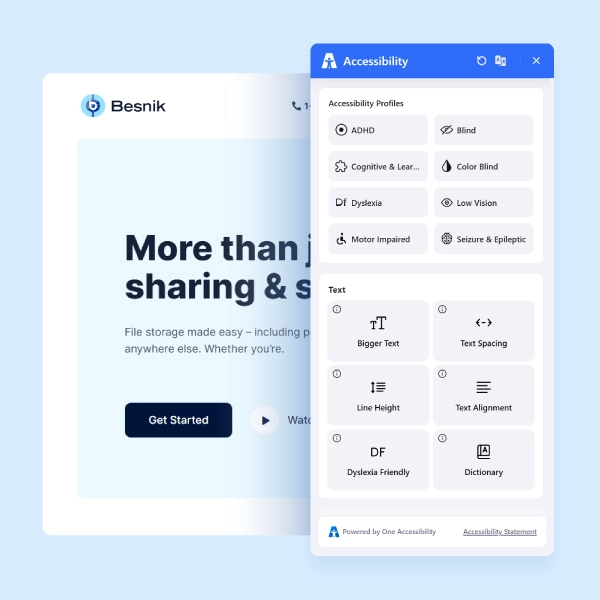
Text Resizing
Visitors can increase or decrease text size to their comfortable reading level.
High Contrast
Toggle high contrast mode for visual impairments or light sensitivity.
Keyboard Navigation
Enhanced keyboard navigation for users who cannot use a mouse.
Screen Reader Ready
Markup compatible with JAWS, NVDA, VoiceOver, and other screen readers.
Reading Mask
A reading guide overlay that helps users with dyslexia follow lines of text.
Instant Activation
Default preset activates on install and improves your site immediately.
Make Your WordPress Site Section 508-Ready
Join thousands of sites using One Accessibility to meet global accessibility standards — no coding required.