

LBI: Brazilian Law for the Inclusion of People with Disabilities
The Brazilian Inclusion Law (LBI), Law No. 13.146/2015, also known as the Statute of Persons with Disabilities, is the main federal legislation in Brazil that guarantees the rights of people with disabilities, including full digital accessibility on websites, applications, and online services.
What is LBI?
The Brazilian Law for the Inclusion of Persons with Disabilities (LBI), Law No. 13.146, was enacted on July 6, 2015, and came into force in January 2016. Based on the UN Convention on the Rights of Persons with Disabilities, the LBI represents Brazil's most comprehensive legal framework for guaranteeing equal opportunities and eliminating barriers in all aspects of social life.
The LBI applies to public bodies at all levels (federal, state, and municipal), private companies, educational institutions, and service providers operating within Brazilian territory. Non-compliance subjects organizations to administrative sanctions, public civil actions by the Public Prosecutor's Office, and individual lawsuits.
For digital accessibility, the LBI mandates that websites and applications must be accessible, with the federal government obligated to follow the eMAG (Accessibility Model in Electronic Government) and the international standard WCAG 2.1 Level AA as a recognized technical reference.
“The Brazilian Law for the Inclusion of Persons with Disabilities (LBI) is based on the Convention on the Rights of Persons with Disabilities and its Optional Protocol, ratified by Brazil with the equivalent status of a constitutional amendment, and aims to ensure and promote, under conditions of equality, the exercise of fundamental rights and freedoms by persons with disabilities.”
The Five Pillars of LBI
The LBI is structured around five main pillars that cover all dimensions of the life of a person with a disability, from health and education to digital access and access to justice.
Accessibility
Eliminating barriers in physical spaces, transportation, communication, technology, and digital environments.
Inclusive Education
Guaranteed enrollment, reasonable accommodations, and specialized educational support at all levels of education.
Work & Employment
Hiring quotas, prohibition of discrimination, and the obligation to make reasonable accommodations in the workplace.
Health & Rehabilitation
Comprehensive healthcare, rehabilitation, provision of assistive technologies and orthotics through the Brazilian public health system (SUS).
Access to Justice
Full legal capacity, guardianship as an exceptional measure, and equal access to the justice system.
To Whom Does the LBI Apply?
The LBI has national scope and applies to both the public and private sectors, with distinct obligations for each.
Organizations Required to Comply
- All bodies and entities of the federal, state, and municipal public administration
- Private companies that offer products, services, or digital content to the Brazilian public
- Public and private educational institutions at all levels
- Healthcare, transportation, tourism, and leisure service providers
- Websites, apps, and digital platforms accessible in Brazil
- Construction companies, developers, and condominium administrators
Public Sector vs. Private Sector
- Federal government: Obligation to comply with eMAG and WCAG 2.1 AA for all government websites and systems
- States and municipalities: Must ensure digital accessibility; may adopt eMAG or WCAG 2.1 AA
- Private companies: Discrimination is prohibited; inaccessible websites may result in lawsuits and sanctions
- Educational institutions: Required to provide accessible materials and make reasonable accommodations
- The law allows for a defense based on "disproportionality" only in specific and proven cases
Key Milestones and Deadlines of the LBI
The LBI established gradual implementation deadlines, with some obligations already in effect and others in the process of being regulated.
| Requirement | Who does it apply to? | Term | Status |
|---|---|---|---|
| LBI enacted: general rights and obligations in force | All sectors in Brazil | Jan 2016 | In Effect |
| eMAG 3.1 — accessibility of federal government websites | Federal government agencies | 2014 (reaffirmed) | In Effect |
| Accessibility in information and communication technology (ICT) | Public and private sectors | Jan 2016 | In Effect |
| Hiring quotas — 2% to 5% of people with disabilities in companies with 100+ employees | Private companies with 100+ employees | In effect | In Effect |
| Regulation of Digital Accessibility Standards for the private sector | Private companies, all sectors | In progress | Pending |
| eMAG update to WCAG 2.2 and emerging standards | Federal government | Expected | Planned |
Penalties for Non-Compliance
Failure to comply with the LBI exposes organizations to administrative sanctions, fines, public civil actions by the Public Prosecutor's Office, and individual lawsuits — in addition to serious reputational damage.
Administrative Fine
Regulatory bodies may impose fines and order the suspension of services or activities until the situation is rectified.
Public Civil Action
The Federal and State Public Prosecutor's Offices can file a class action lawsuit demanding immediate adjustments and collective reparations.
Judicial Process
People with disabilities can individually file lawsuits and obtain compensation for moral and material damages.
Civil Inquiry
The Public Prosecutor's Office can initiate a civil inquiry to investigate systematic non-compliance with the LBI.
Reputational Damage
Cases of non-compliance gain public visibility and impact on social media, causing lasting damage to the organization's image.
Suspension of Contracts
Companies that fail to comply may be suspended from bidding processes and contracts with the public sector.
What Does LBI Require for Websites and Apps?
LBI and eMAG align with WCAG 2.1 Level AA as a technical standard for digital accessibility — structured around four fundamental principles.
Text Alternatives
All non-textual content, images, icons, and buttons must have a text alternative for screen readers and assistive technologies.
Time-Based Media
Pre-recorded videos should have subtitles and audio description. Live streams require real-time captions.
Adaptable Content
Content should be able to be presented in different ways without loss of information, including through assistive technologies.
Color Contrast
Minimum ratio of 4.5:1 for normal text; 3:1 for large text. Information cannot depend solely on color.
LBI vs. Other Accessibility Laws
Understand how the LBI positions itself within the global landscape of digital accessibility legislation.
| Law | Country / Region | Applies to | Web Standard |
|---|---|---|---|
| LBI | Brazil | All sectors operating in Brazil | WCAG 2.1 AA / eMAG |
| DDA | Australia | All sectors in Australia | WCAG 2.1 AA |
| AODA | Ontario, Canada | Organizations in Ontario with 1+ employees | WCAG 2.0 AA |
| EAA (EU Directive 2019/882) | European Union | Private sector B2C in all EU countries | WCAG 2.1 AA |
| ADA | USA | US federal companies and entities | WCAG 2.1 AA (judicial interpretation) |
| Equality Act 2010 | United Kingdom | Service providers, employers and the public sector | WCAG 2.1 AA (mandatory public sector) |
LBI Compliance Checklist
Use this checklist to assess your website's accessibility under the Brazilian Inclusion Law.
Content and Media
- All images have descriptive and meaningful alternative text
- Videos have accurate subtitles and transcripts are available
- Audio content has an alternative text or transcript version
- PDFs and documents are accessible or made available in an alternative format
- Headings follow the correct hierarchy (H1 → H2 → H3)
Visual Design
- Text contrast meets the minimum ratio of 4.5:1 with the background
- Large text meets the minimum contrast ratio of 3:1
- Content is usable with 200% text zoom in the browser
- Color is not the only way to convey information to the user
- Focus indicators are visible when navigating with a keyboard
Navigation and Keyboard
- All interactive elements are accessible and operable via keyboard
- Link to skip to main content available for keyboard users
- No keyboard traps — users can freely enter and exit components
- Consistent and predictable navigation across all pages of the site
- Unique and descriptive page titles on each page
Forms and Customer Service Channel
- All form fields have visible labels that are programmatically associated
- Error messages clearly identify the problem and indicate how to fix it
- Contact or feedback channel regarding accessibility is published on the website
- Documented and publicly available accessibility statement
- Internal process for receiving and processing accessibility requests and complaints
Comply with LBI with One Accessibility
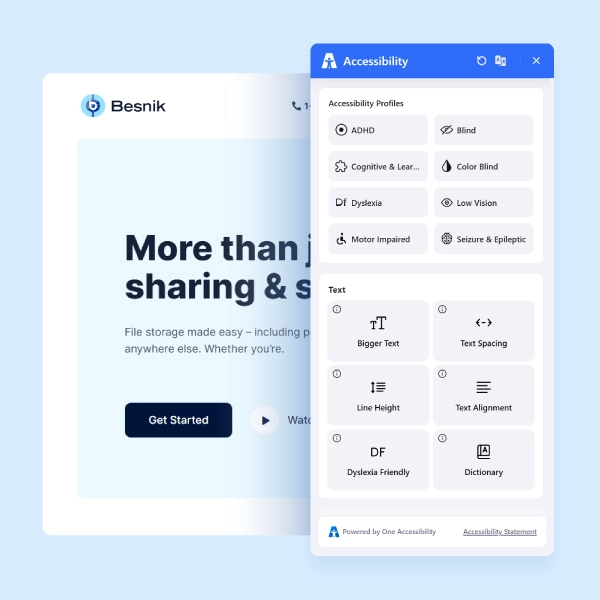
One Accessibility is a WordPress plugin designed to help website owners achieve and maintain compliance with digital accessibility, including the WCAG 2.1 AA standards required by LBI and eMAG for websites.
- Works with Elementor, Gutenberg, Bricks, Beaver Builder, Divi, and WPBakery
- Smart conditional presets, different settings for different pages
- Visual editor with drag and drop, no coding required
- The default accessibility preset is enabled immediately upon installation
- Aligned with WCAG 2.1 AA, technical reference for LBI and eMAG
Text Resizing
Visitors can increase or decrease the text size to their comfortable reading level.
High Contrast
Activate high-contrast mode for users with visual impairments or light sensitivity.
Keyboard Navigation
Enhanced keyboard navigation support for users who do not use a mouse.
Screen Reader Ready
Markup fully compatible with JAWS, NVDA, VoiceOver, ORCA, and other screen readers.
Reading Guide
A reading guide overlay that helps users with dyslexia follow the lines of text.
Immediate Activation
Default preset activates upon installation, instantly improving your website's accessibility.
Frequently Asked Questions
Common questions about LBI compliance, who it affects, and what organizations need to do to ensure digital accessibility in Brazil.
Make Your WordPress Site LBI-Ready
Join thousands of sites using One Accessibility to meet global accessibility standards — no coding required.