


EAA: European Accessibility Act (2025)
The European Accessibility Act is the EU's landmark law requiring private sector businesses to make their digital products and services accessible to people with disabilities. If your business serves consumers in any EU member state, compliance is now a legal obligation.
EAA Requirements for Businesses in the EU
The European Accessibility Act (EAA), officially Directive (EU) 2019/882, was adopted by the European Parliament and the Council on 17 April 2019. Member states were required to transpose it into national law by 28 June 2022, and enforcement began on 28 June 2025.
For the first time in the EU, these requirements extend broadly to the private sector. The previous Web Accessibility Directive applied only to public sector bodies. The EAA brings e-commerce, banking, transport, telecommunications, and other consumer-facing industries under a single harmonized framework.
The technical standard for EAA compliance is EN 301 549. For web content and mobile apps, EN 301 549 incorporates WCAG 2.1 Level AA as its core technical requirement.
“Accessible websites are easier to use for everyone, including older users, people with temporary impairments, and mobile users. Accessibility is not just about meeting a legal threshold. It is about building experiences that genuinely work for every visitor.”
EAA Implementation Timeline
Directive Adopted
EU Directive 2019/882 sets harmonized accessibility framework across 27 member states.
National Laws
Each member state transposes the Directive — e.g. BFSG in Germany.
Enforcement 2025
New products and consumer services must meet EAA requirements from June 28, 2025.
EN 301 549
EU harmonized standard incorporating WCAG 2.1 AA for web content.
Transitional 2030
Legacy products in service delivery infrastructure have until June 28, 2030.
Who Does the EAA Apply To?
The EAA applies to businesses offering covered products or services to consumers in any EU member state, regardless of headquarters location.
Businesses That Must Comply
- E-commerce platforms and online retailers selling to EU consumers
- Banking and financial service providers offering consumer-facing digital services
- Telecommunications providers, including messaging and internet services
- Passenger transport services offering websites, apps, ticketing, and travel information
- Audiovisual media services and digital content platforms
- Any non-EU business offering covered digital products or services to EU consumers
Exemptions (Limited)
- Microenterprises: fewer than 10 employees and under €2M annual turnover (service obligations only)
- B2B-only services: exclusively serving other businesses, not the general public
- Archived content: websites not updated or edited after 28 June 2025
- Disproportionate burden: requires documented evidence and is strictly assessed
Note: The microenterprise exemption applies only to service obligations. Microenterprises that manufacture covered products must still meet product accessibility requirements.
Key EAA Compliance Deadlines
| Requirement | Who It Applies To | Deadline | Status |
|---|---|---|---|
| National transposition of the EAA into law | All EU member states | 28 June 2022 | Past Due |
| New products placed on the EU market | All covered manufacturers and distributors | 28 June 2025 | Required Now |
| New and existing services provided to consumers | All covered service providers | 28 June 2025 | Required Now |
| Legacy products used in service delivery | Service providers using pre-2025 infrastructure | 28 June 2030 | Transitional |
| Long-life self-service terminals installed before June 2025 | Terminal operators | 28 June 2045 | Extended |
Penalties for Non-Compliance
Enforcement is carried out by national market surveillance authorities in each member state.
Up to €100,000 per violation
Maximum fines in Germany and Italy; France can impose up to €75,000 or 4% of annual revenue.
Product or Service Withdrawal
Authorities can order non-compliant products removed from sale or services suspended.
Daily Fines
Several EU member states impose daily fines of up to €1,000 for ongoing non-compliance.
Private Legal Action
Civil society organizations and consumers can file complaints and emergency injunctions.
Multi-Country Exposure
A single violation can trigger penalties in multiple member states simultaneously.
Reputational Damage
Public enforcement actions cause lasting brand damage beyond financial penalties.
What EAA Compliance Requires for Websites
The EAA's technical requirements are defined by EN 301 549, which incorporates WCAG 2.1 Level AA as its web accessibility baseline.
Text Alternatives
All non-text content must have descriptive text alternatives for screen reader users.
Captions and Transcripts
Pre-recorded audio and video must include accurate captions and audio descriptions.
Adaptable Content
Content must be presentable in different ways without losing meaning.
Color Contrast
Normal text must meet 4.5:1; large text requires 3:1 minimum.
EAA vs. Other Accessibility Standards
| Law | Region | Applies To | Web Standard | In Force |
|---|---|---|---|---|
| EAA (Directive 2019/882) | EU (all 27 member states) | Private sector B2C businesses | WCAG 2.1 AA (EN 301 549) | 28 June 2025 |
| WAD (Web Accessibility Directive) | EU | Public sector bodies only | WCAG 2.1 AA (EN 301 549) | 2018/2019 |
| BFSG | Germany | Private B2C businesses in Germany | WCAG 2.1 AA (EN 301 549) | 28 June 2025 |
| ADA (Title III) | USA | US businesses and commercial entities | WCAG 2.1 AA (court-interpreted) | Ongoing |
| AODA | Ontario, Canada | All organizations with 1+ employees | WCAG 2.0 AA | 2021 |
| WCAG 2.1 Level AA | Global | Referenced by most national laws | The standard itself | Global reference |
EAA Website Compliance Checklist
Content and Media
- All images have meaningful, descriptive alt text
- Videos have accurate captions and transcripts
- Live video content provides real-time captions
- Audio content has a text alternative
- PDFs available in accessible formats upon request
- Headings used in correct hierarchical order
Visual Design
- Text contrast meets 4.5:1 minimum
- Large text meets 3:1 contrast ratio
- Content usable at 200% browser zoom
- Color is not the only means of communicating information
- Focus indicators clearly visible for keyboard users
Navigation and Keyboard
- All interactive elements reachable via keyboard alone
- Skip navigation link present
- No keyboard traps anywhere on the site
- Navigation consistent across all pages
- Page titles unique and descriptive on every page
Legal and Administrative
- Accessibility statement published on the website
- Feedback mechanism available for users to report barriers
- Compliance documentation maintained for authorities
- Mobile apps audited against EN 301 549 Chapter 11 if applicable
Meet EAA Requirements with One Accessibility
One Accessibility helps website owners achieve EAA compliance, including the WCAG 2.1 AA standards required under EN 301 549.
- Works with Elementor, Gutenberg, Bricks, Beaver Builder, Divi, WPBakery
- Smart conditional presets for different pages
- Visual drag-and-drop editor, no coding required
- Default accessibility preset activates instantly on installation
- Aligned with WCAG 2.1 AA, the EAA web compliance baseline via EN 301 549
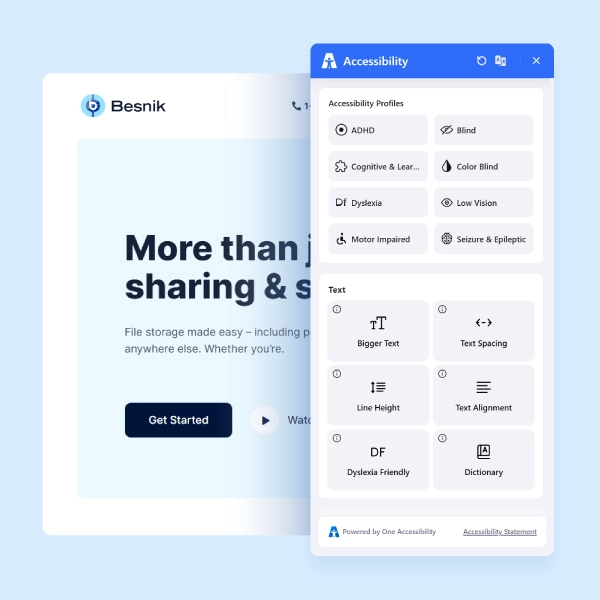
Text Resizing
Content remains functional at 200% zoom per WCAG requirements.
High Contrast
Helps meet WCAG 1.4.3 color contrast requirements.
Keyboard Navigation
Core requirement under the EAA's Operable principle.
Screen Reader Ready
Supports the EAA's Robust principle and proper ARIA implementation.
Reading Mask
Supports Understandable and Perceivable principles.
Instant Activation
Default preset activates on install — your site improves immediately.
Make Your WordPress Site EAA-Ready
Join thousands of sites using One Accessibility to meet global accessibility standards — no coding required.